Make-Ahead Breakfast Casserole with Sausage and Cheddar
Layer bread, sausage, veggies and cheddar with eggs the night before, then bake this golden, sliceable breakfast casserole in the morning.

- Prep
- 20 min
- Cook
- 1 hr 15 min
- Chill
- 8 hr 40 min
- Total
- 10 hr 15 min
- Serves
- 12
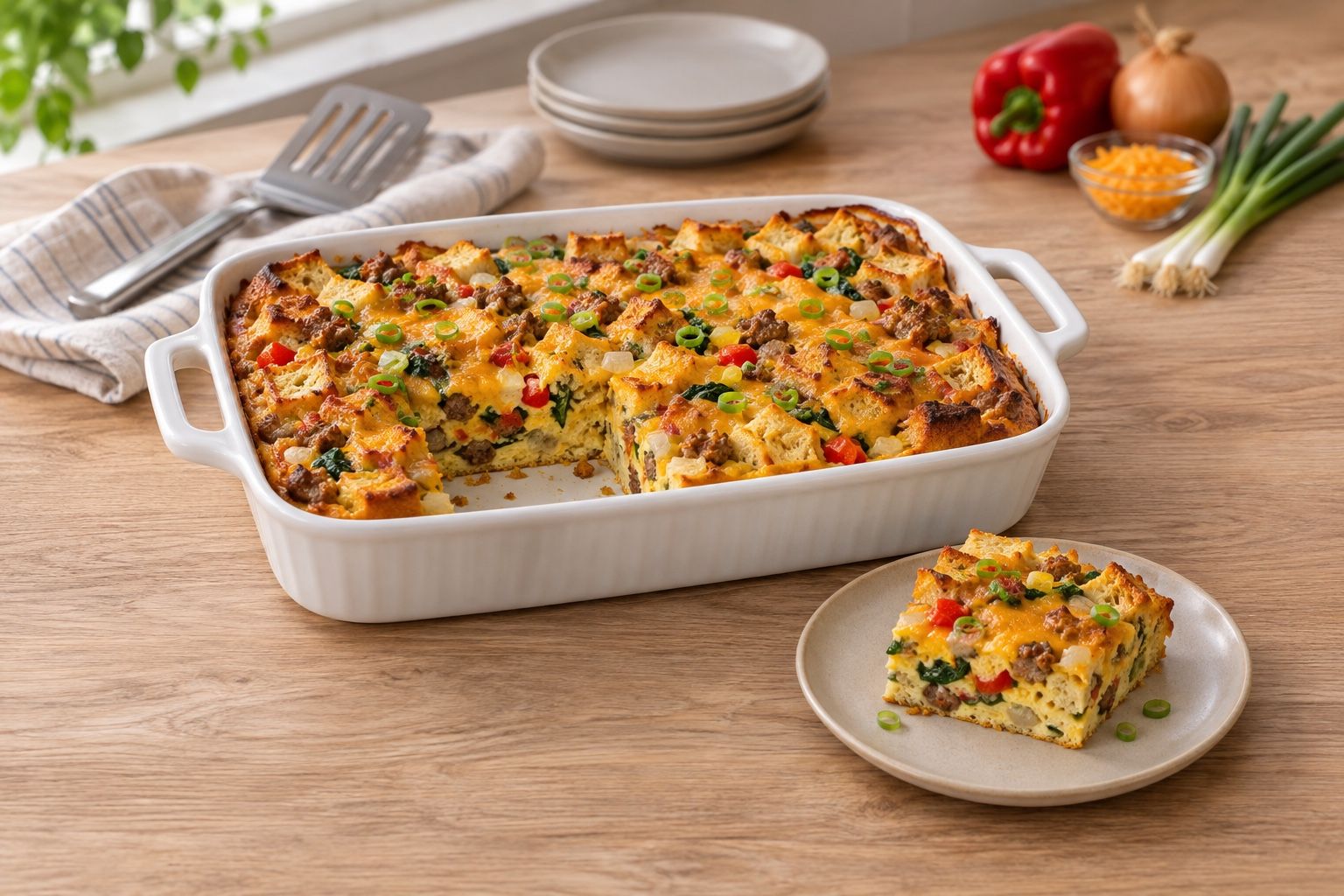
Busy mornings go better with a plan, and this make-ahead breakfast casserole is ours. You layer crusty bread cubes, browned sausage, peppers, onion, spinach and sharp cheddar in a 9x13-inch dish. Then you pour a simple egg custard over the top and let the fridge do the work overnight.
By morning, the bread has soaked up all that custard, so all that's left is to slide the dish into the oven. It bakes up puffed and golden with crisp edges and a tender center that slices cleanly.
We love it for holiday brunches and weekday meal prep alike. One pan makes 12 generous squares, and leftovers keep in the fridge and reheat nicely for 3 to 4 days.
How We Developed This Recipe
- Most of the versions we compared use a dozen eggs in a 9x13-inch dish and bake between 350°F and 375°F, but they split on the base: some layer in bread cubes, some use hash browns, and some skip the starch entirely. We went with day-old bread because it soaks up the custard overnight and bakes into a sliceable, tender casserole that holds up well for reheating. We also cook the sausage and vegetables first and cook the spinach until its liquid evaporates, since extra moisture is the main reason these casseroles turn soggy in the middle.
Why You’ll Love It
- Assemble it the night before, then bake straight from the fridge in the morning.
- Day-old bread soaks up the egg custard for a tender, sliceable casserole with golden, crisp edges.
- Sausage, peppers, onion, spinach and sharp cheddar in every bite.
- Feeds a crowd from one 9x13-inch dish and reheats well for 3 to 4 days.
Ingredient Notes & Swaps
- Day-old bread
- A sturdy loaf like French bread, Italian bread or sourdough works best. Slightly stale cubes soak up the custard without turning to mush. If your bread is fresh, toast the cubes in the oven for about 10 minutes to dry them out.
- Breakfast sausage
- Bulk pork breakfast sausage gives the most flavor. Mild, sage or hot all work. Drain off extra grease so the casserole doesn't turn oily.
- Whole milk
- Whole milk makes a tender custard that sets nicely. Half-and-half gives a richer result; skim milk can bake up a bit watery.
- Sharp cheddar
- Shred it yourself from a block if you can. It melts more smoothly than pre-shredded cheese, which is coated to keep it from clumping.
- Dry mustard
- Just a little brightens the eggs and cheese without tasting like mustard. Leave it out if you don't have it.
Tips for Success
- Soggy middle? It usually comes from watery vegetables or fresh, soft bread. Cook the vegetables until the pan is dry and use day-old or toasted bread cubes.
- Rubbery or weeping eggs usually mean the casserole baked too long. Start checking at 50 minutes and pull it once the center hits 160°F.
- Use a glass or ceramic 9x13-inch dish, and don't move it from the fridge straight into a hot oven without the counter rest, since a sudden temperature change can crack it.
- Press the bread down into the custard before chilling so no dry, crunchy cubes stick up on top.
- Shred your own cheddar for a smoother, creamier melt.
Variations
- Vegetarian: Skip the sausage and add 8 oz sliced mushrooms, cooked with the onion and pepper until their liquid evaporates.
- Hash brown base: Swap the bread for 4 cups thawed frozen diced hash browns, patted dry.
- Ham and Swiss: Use 2 cups diced cooked ham in place of the sausage and shredded Swiss in place of the cheddar.
- Southwest style: Use pepper jack cheese, add a 4-oz can of diced green chiles (drained), and top with chopped cilantro.
Storage & Reheating
- Fridge
- Cool leftovers, then cover the dish or move slices to airtight containers. Refrigerate for 3 to 4 days.
- Freezer
- Wrap cooled, baked slices individually in plastic wrap and foil, then freeze for up to 2 to 3 months. Thaw overnight in the fridge before reheating.
- Reheat
- Microwave a slice covered with a damp paper towel in 30-second bursts, or reheat the dish covered with foil at 350°F for 15 to 20 minutes. Heat until it reaches 165°F in the center.
Frequently Asked Questions
How far in advance can I assemble a breakfast casserole before baking?
Assemble it up to 24 hours ahead and keep it covered in the fridge. Give it at least 8 hours so the bread has time to soak up the custard.
Can I freeze a breakfast casserole before or after baking?
We recommend freezing it after baking. Unbaked egg custard can turn watery and grainy once thawed, while baked slices freeze and reheat nicely.
Should I cook the sausage and vegetables before adding them to the casserole?
Yes. Cooking the sausage fully and softening the vegetables drives off fat and moisture, which keeps the casserole from turning greasy or soggy.
Why is my breakfast casserole watery or soggy in the middle?
Usually it's wet vegetables, soft fresh bread, or an underbaked center. Cook the vegetables until the pan is dry, use day-old bread, and bake until the center reaches 160°F.
How do I know when a breakfast casserole is fully cooked?
The top should be puffed and golden, and a knife in the center should come out clean with no liquid egg. An instant-read thermometer in the center should read 160°F.
Recipe
Make-Ahead Breakfast Casserole with Sausage and Cheddar
Prep 20 minCook 1 hr 15 minChill 8 hr 40 minTotal 10 hr 15 minYield One 9x13-inch casserole (12 squares)
Ingredients
Casserole
Egg custard
For serving
Equipment9x13-inch baking dish · Rimmed sheet pan (if toasting fresh bread) · Large skillet · Large mixing bowl · Whisk · Slotted spoon · Aluminum foil · Instant-read thermometer
Instructions
Assemble the night before
- Dry the bread and prep the dishIf your bread is soft and fresh, heat the oven to 350°F and toast the cubes on a rimmed sheet pan for 8 to 10 minutes, until dry to the touch but not browned, then let them cool. Grease a 9x13-inch baking dish with butter or nonstick spray and spread the bread cubes in an even layer over the bottom.Tip: Day-old bread that already feels dry can skip the toasting and go straight into the dish.
- Brown the sausageCook the sausage in a large skillet over medium-high heat, breaking it into small crumbles, until no pink remains and it's browned in spots, 7 to 9 minutes. Spoon it over the bread with a slotted spoon, leaving the grease behind. Pour off all but about 1 tablespoon of fat.
- Soften the vegetablesAdd the onion and bell pepper to the skillet and cook over medium heat, stirring often, until soft and the onion looks translucent, about 5 minutes. Stir in the garlic and cook until fragrant, about 30 seconds.
- Wilt the spinachAdd the spinach and stir just until it wilts and any liquid in the pan cooks off, 1 to 2 minutes. Spread the vegetables over the sausage, then sprinkle 1 1/2 cups of the cheddar on top.Tip: Make sure the pan looks dry before you add the vegetables to the dish. Extra liquid here leads to a soggy center later.
- Whisk the custardIn a large bowl, whisk the eggs until no streaks of white remain. Whisk in the milk, salt, pepper and dry mustard until smooth.
- Pour, press and chillPour the egg mixture evenly over the casserole. Gently press down on the bread with a spatula so every cube gets soaked. Sprinkle with the remaining 1/2 cup cheddar, cover tightly with foil, and refrigerate for at least 8 hours or up to 24 hours.
Bake in the morning
- Rest while the oven heatsTake the casserole out of the fridge and let it sit on the counter while you heat the oven to 350°F, about 20 to 30 minutes. Keep the foil on.Tip: This short rest takes the chill off the dish so the center cooks through before the edges dry out.
- Bake until setRemove the foil and bake for 50 to 60 minutes, until the top is puffed and golden, the edges are crisp, and a knife inserted in the center comes out clean with no runny egg. The center should read 160°F on an instant-read thermometer.Tip: If the top browns before the center is set, lay a sheet of foil loosely over the dish for the rest of the bake.
- Rest and serveLet the casserole rest for 10 minutes so it firms up and slices cleanly. Cut into 12 squares and top with green onions, if you like.
Notes
- If you're short on time, chill the assembled casserole for at least 2 hours. The bread won't be quite as soft, but it will still bake up well.
- The casserole may need a few extra minutes in the oven if your fridge runs very cold.
Nutrition (per serving, estimated)
- Calories
- 315
- Protein
- 19 g
- Carbs
- 14 g
- Fat
- 20 g
Saturated fat 9 g · Fiber 1 g · Sugar 3 g · Sodium 640 mg · Cholesterol 230 mg

About the author
Julia Hartman
Julia Hartman writes breakfast and brunch recipes, from weekday eggs to make-ahead casseroles. She keeps morning recipes short, with do-ahead notes so most of the work can happen the night before.
More recipes by Julia